About Venera
Born in 1990 in Essentuki, Russia. Currently based in New York.
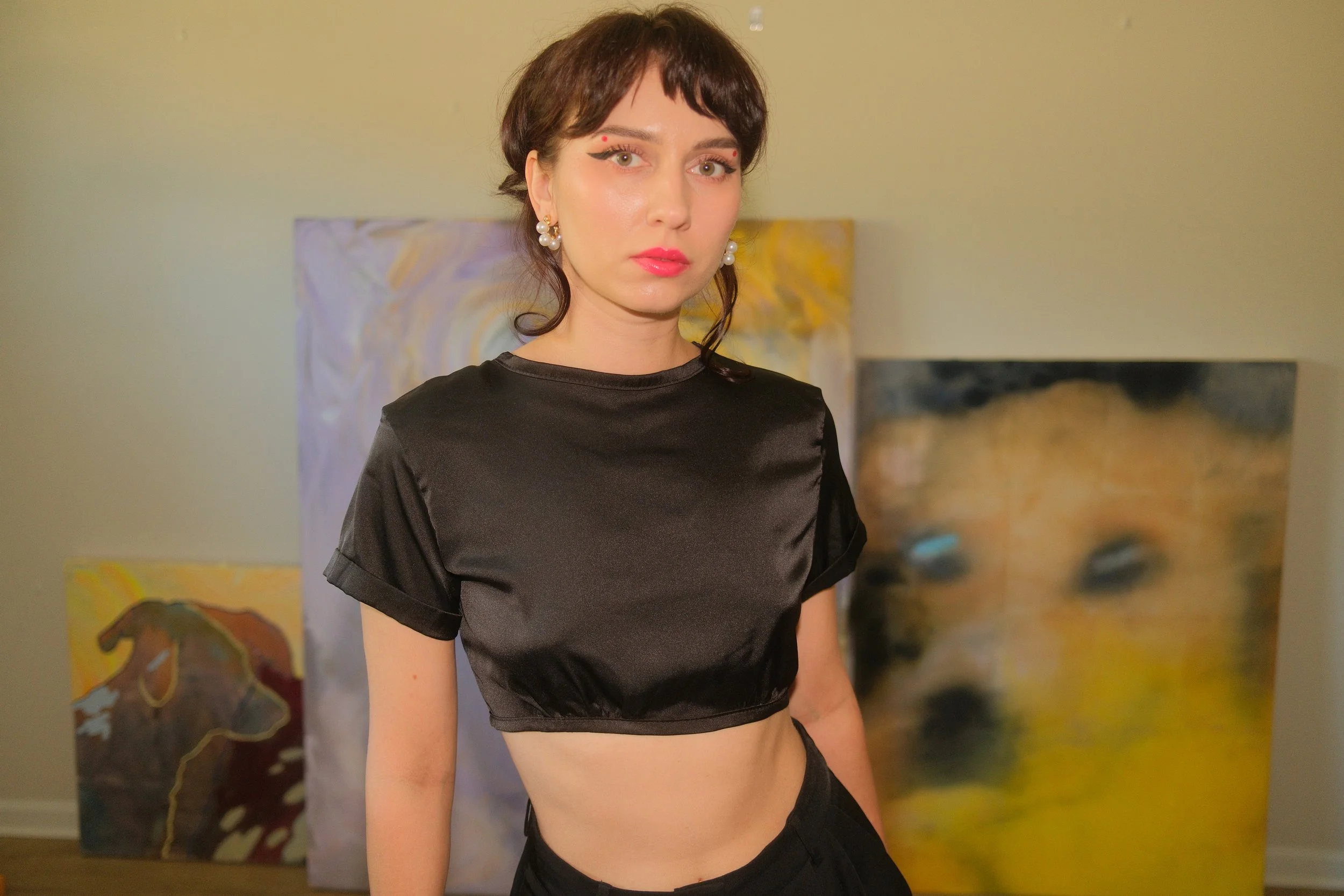
Venera Mor studied at art school and took private lessons in painting, drawing, and photography. She worked as an event photographer before going on to study and work as an architect in Russia for several years. In 2017, she left architecture to pursue art full-time.
For Venera, painting became a project of immortality — a space where photography's influence on her visual language and something harder to name exist on the same canvas.
Her work has appeared at charity auctions and resides in private collections around the world.
Artist Statement
I explore memory as an unstable construction — something that doesn't simply exist in the past, but is assembled, again and again, in the present.
The starting point is personal. When I was 13, my father died. My memories of him slowly collapsed into photographs. Without them, whole moments would cease to exist. That realization made me question whether memory is a record at all — or something far less certain.
I think of memory as neural reconstruction: each time we remember, the brain rebuilds the experience from scratch. What I remember differs from what you remember of the same moment. The past is not a fixed reality. It is a subjective, distorted reconstruction — filtered through the self that exists right now.
This is what I make visible in my work. Every painting begins with a photograph I took myself — an attempt to hold a moment still. I transfer ink from the photograph onto the canvas, taking the image away from its original surface. What remains is a ghost: a partially destroyed impression, like a memory already beginning to slip away.
Over that trace, I paint and draw — in oil, acrylic, ink, and whatever the work demands. I distort, interrupt, and add. My marks act as flashes of neural activity — sudden images, emotions, fragments. They conflict with the original photograph, transforming it. The moment is no longer what it was.
Visually, my paintings hold two realities at once: something recognizable and something abstracted beyond recognition. This tension mirrors memory itself — shaped by loss, time, and who we've become since.
For me, painting is an act of resistance against disappearance — an attempt to hold what is escaping, knowing that in holding it, I will change it. The canvas becomes a place where the static trace comes alive, where memory regains a body, and where forgetting and preserving exist in the same gesture.